SKU: 48076184012
young money tree

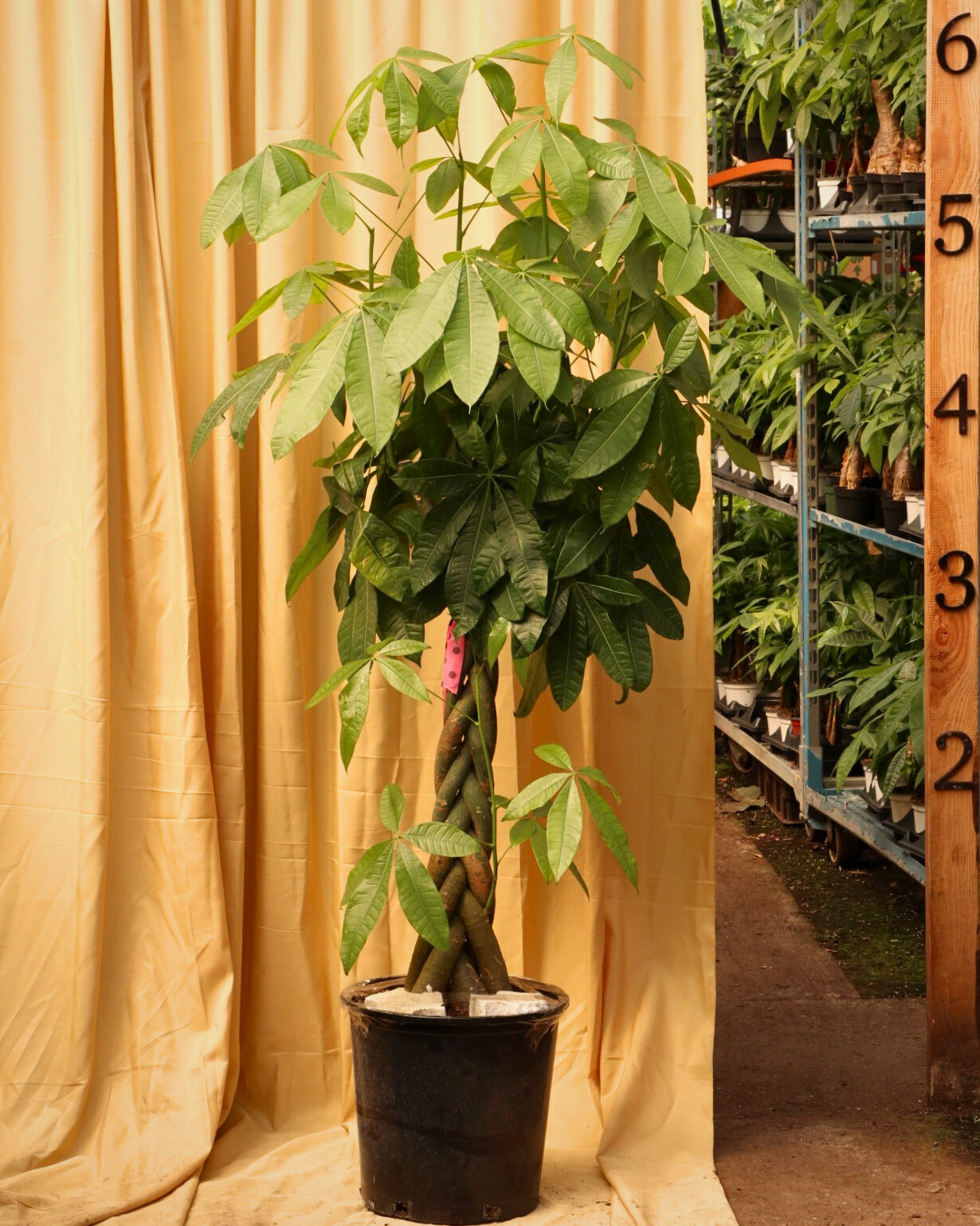
young money tree Full Size Money Tree

Sale price$23.89 Regular price$26.54
Save 10%

Shipping Estimate
USA
  • USA
  • CAN

Ships within 48 hours · Estimated delivery Jul 11 - Jul 16

Promo Codes Available:

For Your Every Summer RSVP, with Code: SUMMER15

Description

young money tree Full Size Money TreeIf youre looking for good luckand a large houseplantthen look no further. Mr. Money Trees beautifully braided, swirling trunk traps good fortune. Not just good luck, but also a good income. Its leaves grow in groups of six, possibly representing six figures. Plus, the whole thing just looks striking. Money Tree benefits Some say a Money Tree can even promote healthier sleep, reduce stress, and decrease conflict in the home. We cant confirm the science

If you’re looking for good luck—and a large houseplant—then look no further. Mr. Money Tree’s beautifully braided, swirling trunk traps good fortune. Not just good luck, but also a good income. Its leaves grow in groups of six, possibly representing six figures. Plus, the whole thing just looks striking.


Money Tree benefits

Some say a Money Tree can even promote healthier sleep, reduce stress, and decrease conflict in the home. We can’t confirm the science behind those beliefs, but research does suggest that the Money Tree is an effective air purifier.


Place this adorable plant beside your bed at night, and take a deep breath. You just might sleep better and feel at ease, and you’ll definitely be breathing in cleaner air!


The Money tree looks cool

Scientifically known as the Pachira Aquatica, the Money Tree is a wetland plant native to Central and South America. Each “Money tree” is actually made up of multiple Pachira Aquaticas, gently hand woven together as they grow to maturity. Thanks to the Money Tree’s umbrella-like foliage, the plant’s swirling trunks look like they’re dancing in the rain, adding whimsy and romance to your indoor garden.


The Money Tree is pet-friendly and non-toxic

Money Trees are non-toxic to cats and dogs. We can’t stop your pet from nibbling on your precious Money Tree, but it won’t end in their demise. (We’ll send all the good vibes to your devoured Money Tree, though).


Lighting

Money Trees love low-light spots, even really low light, and they’ll bring you joyful thoughts even from a shady corner—or in bright indirect light. Money can’t buy happiness, but it can buy plants, which is almost the same thing?


Watering

Most houseplants can’t tolerate much trial and error when it comes to watering. But the Money tree is flexible! Money trees kinda like damp soil (they’re native to swampland after all), so overenthusiastic watering generally won’t kill them.


Pick your exact Money tree 


Now that you're an expert with the Money Tree, order this plant by 7pm ET to get this plant shipped out of our greenhouse in New Jersey tomorrow. (Wondering when it will arrive? Check with the zip code validator on top of the “Add To Cart” button.) We’ll deliver your Money Tree in our sustainable, super-secure packaging system, no matter where you live in the U.S. Your plants will arrive safe and intact!


Hop on a video call to select your Money Tree, and we WILL send out the EXACT plant that you picked out, just like if you picked it up at a local nursery or garden center. Except we have more and fresher plants to choose from, and you can't find our PAFE fine ceramic planter options anywhere other than our website. :)


For any other questions or concerns, please don't hesitate to reach out to us at [email protected] or call/text (609)-968-7063! Or if you want to learn more about the Money Tree, keep scrolling!


Money tree benefits


What is a Money tree good for?

The Money tree looks awesome, purifies the air, brightens your home, and—maybe—brings good fortune. That’s a legend, but nobody said legends can’t be based on truth! You should probably test it out, to be on the safe side.


Does the Money tree clean the air or give oxygen?

The Money tree cleans carbon dioxide from the air and replaces it with nice fresh oxygen for us to breathe. It also sucks up chemicals like formaldehyde and benzene, plus other synthetic chemicals from cleaning products, leaving the air cleaner.


Are Money trees easy to keep alive?

Money trees are very low maintenance. They’re not too fussy about their watering schedules or their lighting. However, everyone has something, and Money trees do prefer a narrow range of temperatures (65-75). They also want some humidity. But that’s all.


Money tree care


How often should I water my Money tree?

Water your Money tree every week or two—more often during the spring and summer, and less often in the fall and winter. The Money tree tolerates overwatering better than underwatering, but make sure you’re using well-draining soil.


How do I keep my Money tree happy?

It’s pretty easy to keep a Money tree happy! Water every week or two. Put it anywhere indoors except in direct sun. And sing it a lullaby every night at bedtime. Even easy-care plants don’t mind a little pampering.


Where should a Money tree be placed in the house?

Most importantly, place the Money tree wherever it can get the right lighting—anywhere from bright indirect light to truly low light. But traditionally, for the best luck, the Money Tree is placed in the southeast section of your home.


Do I need to fertilize my Money tree?

Fertilize your Money tree once a month during spring and summer, when it’s really growing. You can use a general-purpose fertilizer—it’s not a picky eater—but dilute it to half-strength and make sure the soil is wet before applying.


What temperature do Money trees like?

The Money tree is a bit fussy, liking a narrow range of indoor temperatures: 65 to 75 degrees. So keep your home at moderate temps year-round. (Finally, you can tell your spouse or Dad to turn up the heat.)


Can Money trees grow without sunlight?

Money trees can live happily in a dark room with little natural light. So if you have a room with teeny tiny windows, or your neighbor’s way-too-close apartment blocks the sun always, it’s ok—Mr. Money tree will be fine.


Should I spray water on my Money tree?

The Money tree does enjoy humidity, and its leaves will get crinkly in low humidity. However, there’s some debate over whether misting helps or not. To be on the safe side, if you live in low humidity, get a humidifier.


Money tree factoids


Why does the Money tree have 6 leaves?

Some say the six leaves symbolize six figures—in other words, the luck from the Money tree might lead to your next promotion. (It’s us, we’re the ones who say that.) No promises, but work really hard just in case.


What is the superstition about Money trees?

Legend says that having a Money tree in your home will bring good luck and possibly even financial fortune. We prefer “legend” over “superstition” because it sounds fancier and makes us look cooler for believing in it.


Is there a difference between a Money tree and a Money plant?

Yes, the Money tree and the Money plant are totally different species. The Money tree is officially Pachira Aquatica, and the most common money plant, the Chinese Money plant, is Pilea Peperomioides—and it’s a small plant, not a tree.


Is the Money tree good for feng shui?

The Money tree is powerful and meaningful in feng shui, especially if you place it in the southeast area of your home. It symbolizes personal and professional growth and is said to bring good fortune to you and your family.


Do Money trees bloom?

In the wild, Money trees often boast glorious fluffy orange blossoms. But that only happens because they’re pollinated by bats. Assuming you don’t keep any bats inside (weirdo), your Money tree is very unlikely to bloom indoors.


How often do Money trees grow money?

Sadly, the legend that Money trees bring wealth and fortune is more of a metaphor than a practical promise. None of our Money trees have ever grown cash, and if they start, we won’t sell them to you anymore!


Why is it called a Money tree?

The Money tree gets its name from the legend, myth, or superstition that it brings financial luck to its owner or household. However, it’s not literal; Money trees don’t grow money (and no one will pay you to own one).


How long do Money trees live indoors?

Even indoors, a Money tree can live ten years or even longer. Of course, it requires TLC, but it’s an easy-care plant so that’s not a tall order. The Money tree will be your botanical companion for a decade.

Shipping Notes
  • Free Standard Shipping on $100+ Orders to the USA.
  • Except Preorder products are shipped in 48 hours.
  • Delivery to the USA:
  1. Standard Shipping : 3-10 business days
  • If time is of the essence, please consider selecting expedited delivery for faster service.
Exchange/Return Notes
  • We offer a 30-day return/exchange service after receiving.
  • Final sale items are not eligible for returns or exchanges.
  • To process your return/exchange, please contact us at [email protected]
  • Please click here for more details>>> Return & Exchange Policy
SKU: 48076184012

Discover Niche Categories That Outsell young money tree

Top-Converting Item to Boost Your Average Order

4.0 ★★★★★
Based on 1145 reviews
Sort
Highest Rating
Newest First
Oldest First
Product Reviews
D
Verified Purchase
Dr. Lee D. Carlson
San Leandro, US
★★★★★ 5
A 50 carat learning gem
The teaching of American history in elementary and middle schools reminds one of the cleaning of a commode: any rings or crud are removed and the bowl is disinfected. It then looks shiny and pretty, as if no foul stuffs were ever deposited in it. The tall tales and antiseptic methodologies employed in the teaching of American history in these citadels of bias are finally being countered by some historians, who are also clearly biased but self-consciously so. They do not hesitate to study the foul stuffs that have been part of the history of the United States, and are willing to put up with the strong odors thereof. What results in their writings is a compilation of the facts that are left unreported by the sycophants of established educational hierarchies. The picture they paint is not a pretty one, but for those who desire the bare, naked truth, and not the stale platitudes of whitewashed historical analysis, it can be a grand viewing. The author of this book is one of these new historians, and he does not hesitate to dig deep into the real stories that have remained hidden for decades. Historical analysis of course is more then muckracking, and requires an accounting of what has occurred in the past without blinders. It also must put to rest the notion that historical events are controlled by a ruling elite, and the latter are not the distinguishing features of history. History is not a history of kings, queens, and princesses. They play a role but it is an ancillary one. The title of this book refreshingly reminds us of this. History is governed and directed by the actions of many individuals, known and unknown. The author calls them "the people", and their story is told unabashedly in this book. The author is clearly a socialist, but his attitude is one of a healthy skepticism towards government, and justified distrust of the military establishment. He reminds us that the draft was in place as early as the Revolutionary War, as were the exceptions granted for avoidance of it. For example in Connecticut Yale students and faculty were exempted from the draft, as were ministers and various government officials. There was also the familiar schism between officers and "ordinary" soldiers, and any in the latter class who chose not to respect this distinction were whipped severely. Wealthy individuals dominated the Continental Congress, but most "ordinary" soldiers were not getting paid. Some groups of "ordinary" soldiers rebelled and some executed by firing squad when the rebellion was suppressed (in one case by soldiers of George Washington himself who led the suppression). The author's commentary and documentation on the Revolutionary War certainly act as a counterexample against the belief that this war had universal support and thought of as a noble cause by the general populace of the time. The Revolutionary War, like all other wars, was an ugly, messy affair, and had its share of false patriotism, brutality, and cowardice, and it affected many other peoples that had no interest or stake in it: native American tribes such as the Iroquois and the Mohawk. These tribes did not come under the umbrella of the Declaration of Independence. Some of these tribes therefore launched, with complete justification, a guerilla war against the new American citizenry, especially when the latter decided to push westward and indulge itself in the forced acquisition of land. The author tells us of the smallpox biological warfare launched against the Appalachian tribes by the British, causing a major epidemic. He tell us of the thousands of black slaves who fought with the British in the Revolutionary War, as did the majority of the Indian tribes. He tell us of the keeping of slaves by Thomas Jefferson throughout his life, of the fact that most of the authors of the Constitution were men of wealth, and none were slaves, indentured servants, women, or men without property. He tell us of Shay's rebellion and its counter, the Riot Act, which allowed authorities to keep people in jail without trial, and of the defiance of Anne Hutchinson against the church fathers in the Massachusetts Bay Colony. He tells us of New Jersey's rescinding of women's right to vote in 1807, of a "feminist" movement as early as the 1840's, and of the founding in 1821 of the Troy Female Seminary by Emma Willard. The author reminds us that the war of 1812 was a conflict waged for expansion into Florida, Canada, and Indian territories, that Congress deliberately and without hesitation appropriated money for war against the Seminoles, and that President Van Buren openly bragged to Congress about the forced removal of Cherokees from lands east of the Mississippi. He reminds us of the doctrine of "manifest destiny" and its justification of the brutal war against Mexico waged by President James Polk in the 1840's with the jingoistic assistance of the newspapers (no other course would be rational some of them reported), with Mexico losing half its territory in the 1848 treaty of Guadalupe Hidalgo. He reminds us of the Anti-Renter movement in the Hudson valley of New York, and that the Renssalaer family at one time ruled over eighty thousand tenants. He reminds us of Dorr's Rebellion in Rhode Island that attacked the idea, and its perpetrators, that only landowners could vote. So yes, there is much in this book that is fascinating and that is food for a hungry and inquisitive mind. It certainly goes against the mainstream view, and any teacher of history will probably come under fire from those who employ them if they decide to discuss the facts and analysis in this book. The history of the United States has been one of brutality mixed with brilliance, the former of which is emphasized in the pages of this book. A future treatise might emphasize the latter, and together they can give a more accurate picture of what the United States is, what it has been, and its future potential.
WAS THIS REVIEW HELPFUL?YesReportShare
Reviewed in the United States on December 30, 2006
D
Verified Purchase
Davut Habip
Fort Morgan, US
★★★★★ 5
An amazing book ...
Format: Paperback
An amazing book. Reading the book helped me understand why the US is experiencing difficulties in "perceived righteousness" today. I would recommend it to anyone who would like to change the World for the better. Howard Zinn is a benevolent hacker: the kind of hacker I would like my children to be, and why not: all children to be. For me, Zinn’s A People’s History of the United States hacks history and defines a problem and offers a solution: 1. The problem: a one-sided patriotic history enslaves the masses, 2. The solution: a bottom-up, humanistic history empowers everyone and opens the doors for future reconciliations among different communities.(1) At this critical juncture of human history both are relevant not only for the US but rather for our race. A one-sided patriotic bias in history: at what cost? 1. hides wrongdoings and the associated guilt, 2. serves as the first line of defense to deflect current & future criticisms for the past & current mistakes, 3. tampers data gathering, silences questioning & divergence of opinions, 4. reduces communication among communities, 5. defines “the patriotic” and increases the chances of populating the armed forces, 6. defines the other: “the unpatriotic,” 7. increases insecurities, 8. evokes fears (of retribution, etc.) 9. can be misused to justify violence against “the other,” 10. builds a common memory for the masses, builds their egos so that these egos can later be exploited, 11. allows the word “culture” to be used as an equivalence: American culture = being American; (2) 12. a politician can mix these facts to incite emotional reactions of the masses and eventually reach a higher number of votes in a predetermined direction, inexpensively, 13. at school, in the media, in speeches of politicians, and during different rituals (starting with reciting the pledge of allegiance and singing of the national anthem) the patriotic history is repeated and reinforced. Under these conditions, the masses learn to repeat what is given to them. They shun away from questioning further. Their concept of free-will is replaced by a misplaced trust. They learn not to deviate from the norm: they are enslaved and are not even aware of this enslavement. Many words lose their meaning: “a more perfect Union” “Justice” “secure the Blessings of Liberty,” “democracy.” A higher degree of cynicism and later a deep feeling of helplessness ensue. There are costs to the individual, the family, the society. Since many worldwide look up to the US morally, the use of one-sided patriotic history in the US produces world leaders who imitate bad examples. Consequently, Humanity pays dearly. A bottom-up, humanistic history empowers everyone: 1. can eliminate ignorance, 2. can eliminate convenient forgetfulness, 3. can eliminate arrogance, 4. improve self-esteem, communication, & understanding 5. can reduce violence, 6. can empower the individuals and the masses: psychologically and economically and thus improve the quality of life, 7. can help the path to sustainable peace. Among the different communities, the wounds are real. A one-sided history often does not address all of these wounds. Denial freezes any possibility of a reconciliation. A reconciliation process would pass through an acceptance of a historical wrong doing. In time, mankind may realize that what Howard Zinn has started may be the building blocks of sustainable peace. As a new year starts, I wish upon all of us: nations, creeds, ethnicities, etc. our very own Howard Zinns. (1) In the US, these communities can be whites, blacks, American Indians, Mexicans, WASPS, Catholics, Jews, Moslems, Chinese, Japanese, etc. In Turkey, where I am from, these communities include the seculars, non-seculars, Alevites, Armenians, Greeks, Jews, Kurds, etc. (2) Most of us are led to believe that “being” American/WASP/Jewish/Moslem/... is a “culture;” we almost always have these attributes thanks to coincidences; i.e. we are born into these “states;” how can a state that is largely a coincidence, be culture? I would suggest that only what is done through our free-will is deemed culture. Interestingly worldwide, the education systems, the media, and politicians use and propagate the word “culture” to imply largely a static state, rather than the result of a willful action.
WAS THIS REVIEW HELPFUL?YesReportShare
Reviewed in the United States on December 24, 2016
L
Verified Purchase
Lyy
Los Angeles, US
★★★★★ 5
Good quality
Format: School & Library Binding
Perfect!
WAS THIS REVIEW HELPFUL?YesReportShare
Reviewed in the United States on April 30, 2026
J
Verified Purchase
Jovana
Houston, US
★★★★★ 5
Great book perfect for history lovers
Format: School & Library Binding
This book is perfect for people who love history in general. Very interesting topic in that it deserts why different cultures became more prominent than others over time. I’m still getting through it, but wanted to write a positive review because I’m enjoying it so much.
WAS THIS REVIEW HELPFUL?YesReportShare
Reviewed in the United States on January 23, 2024
B
Verified Purchase
Bella
West Palm Beach, US
★★★★★ 4
Makes you think!
Format: School & Library Binding
Jared Diamond’s Guns, Germs, and Steel is all about figuring out why some societies became super powerful while others didn’t. His main idea is that geography and the environment had a huge impact. Basically, places with good crops and animals to farm had an easier time growing and becoming stronger. The book mixes history, science, and geography in a way that’s pretty easy to follow, even though it covers a lot. Some people think Diamond focuses too much on geography and doesn’t consider enough other factors, but it definitely makes you think differently about history and why the world is the way it is today. It’s a really interesting read if you’re into learning about why things turned out the way they did.
WAS THIS REVIEW HELPFUL?YesReportShare
Reviewed in the United States on March 22, 2026

recommand products